
Accountability Isn't a Dirty Word. It's a Measurement System.
Amy Morin • March 4, 2026
It's a Measurement System
Say "accountability" in a room full of business owners and watch the energy shift. Shoulders tighten. Eyes narrow. Someone crosses their arms.
That reaction tells you everything about why most companies struggle with it.
We've turned accountability into a weapon. A word that means "who's getting blamed." A post-mortem tool for pointing fingers after something breaks. No wonder people run from it.
Here's the problem with that: accountability isn't punishment. It's measurement. And until your leadership team understands the difference, you'll keep recycling the same problems quarter after quarter.
The Real Definition
Accountability is a system that measures your progress toward outcomes that matter. That's it. No blame. No shame. Just clarity about where you stand versus where you said you'd be.
Think of it like a GPS. Your GPS doesn't judge you for missing a turn. It recalculates. It shows you exactly where you are, exactly where you're headed, and exactly how far off course you've drifted. That's accountability — a navigation system, not a courtroom.
The moment your team sees accountability this way, the culture shifts from defensive to proactive.
Two Sides of the Clarity Coin
Every accountability gap traces back to a lack of clarity in one of two areas. I call this the Accountability Clarity Framework, and it works on two dimensions:
Dimension 1: Actions Taken vs. Actions Not Taken
This is the doing side. What did you actually execute? And what should you have done but didn't?
Most teams only look at failures — the actions not taken. The proposal that didn't go out. The client call that got postponed. The quarterly priority that stalled at 40%.
But accountability also means measuring what you did right. What actions moved the needle? What commitments did you honor? When you track both sides, you build a complete picture. You can replicate success and correct gaps — not just punish misses.
A leadership team I worked with was stuck in a cycle of reviewing what went wrong every quarter. Morale was sinking. Their Rock completion rate hovered around 50%. We flipped the conversation. Instead of starting with failures, we started with wins: "What did you do this quarter that directly supported your Rocks?" The energy in the room changed immediately. People started owning their progress, not just their problems.
Within two quarters, Rock completion jumped to 82%. Not because the work got easier. Because people stopped associating accountability with getting called out and started associating it with getting clear.
Dimension 2: What You Own vs. What You Don't
This is the clarity side. And this is where most organizations hemorrhage time, energy, and trust.
Ask every member of your leadership team this question: "What are you accountable for?" Then compare answers.
If you get six different interpretations of who owns what, you don't have an accountability problem. You have a clarity problem.
When people don't know precisely what they own — and equally important, what they don't own — they either overreach into other lanes or disengage entirely. Both are expensive.
Clarity of ownership means every person on the team can answer four questions without hesitation: What's mine? What's not mine? How is "mine" being measured? And how does what I own drive the success of this company?
That fourth question is the one most leaders skip — and it's the most important. When someone knows they own customer retention and it's measured weekly, that's good. When they also understand that a 5% improvement in retention adds $400K to enterprise value at exit, that's transformational. Accountability without connection to company-wide impact is just task management. Accountability tied to value creation is leadership.
When those answers are crisp, accountability stops being a loaded word and becomes an operating system.
Why This Matters More Than You Think
Owner-dependent companies — businesses where the founder is the chief decision-maker, the chief problem-solver, and the chief accountability officer — don't scale. They stall.
If accountability lives in your head instead of in a system, you're the bottleneck. Every decision routes through you. Every dropped ball lands on your desk. Every "who was supposed to handle this?" conversation ends with you absorbing the work yourself.
That's not leadership. That's captivity.
Companies that build real accountability systems — where every function has measurable outcomes, every team member has clear ownership, and every week includes a structured review against those commitments — those companies create freedom. Freedom for the owner. Freedom for the team. And eventually, freedom to exit on your terms with a business that holds its value because it runs without you.
The Accountability Audit
Here's an exercise you can run with your leadership team in 15 minutes.
Give every team member a blank sheet divided into four quadrants:
The patterns will tell you everything. If the "Not Mine / Did" quadrant is packed, your team is overreaching — doing other people's jobs because boundaries aren't clear. If "Mine / Didn't" is heavy, execution is breaking down. If "Not Mine / Didn't" has entries, you have orphaned accountabilities — work that belongs to no one, which means it belongs to the owner by default.
That last quadrant is where value goes to die.
From Blame to Baseline
Building a culture of accountability isn't about having harder conversations. It's about having clearer ones.
Stop asking "Why didn't this get done?" Start asking "Was it clear who owned it? Was success defined? Was it measured weekly?"
Nine times out of ten, accountability failures aren't character failures. They're system failures. Fix the system and the behavior follows.
Accountability is how you measure the gap between intention and execution. When you treat it as data instead of judgment, your team leans in instead of locking up. The shoulders relax. The arms uncross. And the work actually gets done.
What's one area in your business where ownership is unclear right now? That gap is costing you more than you think.
It means you're growing. Expanding. Pushing the edges of what your current structure, people, and systems can handle. The ceiling is loud — revenue stalls, operations buckle, the leadership team feels it in their bones. And because they feel it, they act. They restructure. They hire. They solve. They break through. That's the ceiling everyone talks about. There's another ceiling nobody talks about. The quiet one. The quiet ceiling doesn't announce itself. There's no dramatic stall, no crisis that forces action. Revenue might be flat or even creeping upward. The team shows up. Clients stay. Payroll clears. From the outside — and from the inside — everything looks stable. Stable is the most dangerous word in business. Because underneath that stability, value is eroding. Slowly. Silently. The kind of erosion you don't notice until someone puts a number on your company and that number is a fraction of what you expected. Why the Quiet Ceiling Is More Expensive Than the Loud One The loud ceiling costs you time. You stall, you scramble, you break through. Six months, maybe a year of disruption. But the problem is visible, so the solution gets resourced. The quiet ceiling costs you years. It costs you the compounding value your business should have been building while you were convinced things were "fine." And by the time you see it — usually when you start thinking about exit, succession, or even just a serious valuation — the gap between where you are and where you should be isn't a dip. It's a canyon. The loud ceiling is a broken bone. It hurts, but you treat it. The quiet ceiling is high blood pressure. No symptoms until the damage is done. The Four Warning Signs You're Under a Quiet Ceiling The quiet ceiling leaves fingerprints. They're subtle, but they're there — if you know where to look. 1. Your margins are flat while revenue holds steady. Revenue is the number everyone watches. Margins are the number that matters. If your top line is stable but your margins haven't improved in two or three years, your business is getting less efficient without getting smaller. Costs are creeping. Pricing power is slipping. Operational waste is accumulating. The business feels the same, but it's worth less every quarter. From an exit planning perspective, a buyer doesn't pay for revenue. They pay for earnings — and the trend line of those earnings. Flat margins over three years tell a buyer your business has peaked. That perception alone can shave significant value off your multiple at exit. 2. The same three people are involved in every decision. You know who they are. Maybe you're one of them. Every major client issue, every operational hiccup, every strategic call routes through the same small group. The rest of the team executes but doesn't decide. This is key-person dependency, and it's one of the most common — and most costly — value destroyers in a private business. When a buyer or advisor looks at your company and sees that removing two or three people would collapse the operation, they discount the value accordingly. Sometimes dramatically. The quiet ceiling here is that the business keeps functioning. Those three people are good at what they do. So the dependency doesn't feel like a problem. It feels like strength. Until one of them leaves, burns out, or you try to sell — and the buyer asks, "What happens to this company without you?" 3. Your top 20% of customers represent more than 50% of revenue. Customer concentration is a silent killer. When a handful of accounts drive the majority of your revenue, you're not running a diversified business. You're running a relationship. And relationships are fragile. Most owners don't see this as a ceiling because the revenue keeps coming. The big clients keep paying. But from a value perspective, customer concentration is one of the highest-risk factors a buyer or advisor will flag. It suppresses your multiple because it increases the risk that your revenue disappears with a single phone call. If you've had the same concentration ratio for three years and haven't actively worked to diversify, you're under a quiet ceiling. The business feels stable. The value says otherwise. 4. Your leadership team hasn't changed how they operate in over a year. Same meeting rhythm. Same issues resurfacing. Same Rocks that look suspiciously similar quarter after quarter. No new tools adopted. No processes challenged. No structure questioned. This is organizational inertia disguised as discipline. In EOS, the system is designed to evolve as the company grows — the Accountability Chart shifts, the Scorecard gets refined, Rocks get more ambitious as the team matures. When none of that is happening, the company isn't running well. It's coasting. Coasting and growing are opposites, even when the P&L doesn't show it yet. The Stability Trap Every one of these warning signs has something in common: the business doesn't feel broken. That's the trap. Owners are wired to respond to crises. When revenue drops 20%, you act. When you lose a key employee, you act. When a major client leaves, you act. But when margins quietly flatten? When dependency slowly calcifies? When concentration creeps up by 2% a year? When the leadership team settles into comfortable routines? There's no alarm. No urgency. No forcing function. So you do what most owners do. You keep running the business the way you've been running it. And every month that passes, the distance between your company's current value and its potential value gets wider. This is what sticking your head in the sand actually looks like. It's not denial about a problem you can see. It's comfort with a situation you can't see clearly enough to question. Breaking Through a Ceiling You Can't Feel The loud ceiling breaks on its own — the pressure forces it. The quiet ceiling requires you to go looking for it. That means two things: Measure what stability is hiding. Your EOS Scorecard should include leading indicators, not just trailing ones. Trailing indicators tell you where you've been. Leading indicators tell you where you're drifting. If your Scorecard hasn't been updated in a year, it's measuring yesterday's business while today's value leaks out the side. Pair that with a value assessment. Not when you're ready to sell — now. A formal look at your business through a buyer's eyes exposes the quiet ceilings that your P&L won't show you. Key-person risk, customer concentration, margin compression, recurring revenue gaps — these are the factors that determine what your business is actually worth versus what you assume it's worth. That gap is the quiet ceiling, expressed in dollars. Challenge the operating rhythm. If your leadership team's L10 agenda, Rocks, and Accountability Chart look the same as they did a year ago, ask why. Growth demands evolution. The EOS tools are designed to tighten, expand, and recalibrate as the company scales. If they're static, the company is static — whether the revenue line admits it or not. The quarterly pulse should feel uncomfortable at least once a year. If every session is smooth, you're either exceptional or asleep. The odds favor the latter. Celebrate the Ceiling. Even the Quiet One. In EOS, hitting the ceiling is a milestone. It means you've outgrown your current capacity. The loud ceiling gets celebrated because it's obvious — it forces the breakthrough that leads to the next level. The quiet ceiling deserves the same response. Once you see it, it's an opportunity. It's the gap between your company's current value and its potential — and closing that gap is the highest-return work you can do as an owner, whether you're planning to exit in three years or thirty. But you have to be willing to look. You have to be willing to question the stability you've built. And you have to accept that "fine" might be the most expensive word in your vocabulary. When was the last time you pressure-tested your business through a buyer's lens — not because you're selling, but because you want to know what "stable" is actually costing you?
You've implemented EOS. You run weekly L10 meetings. But here's what's still happening: It's Wednesday afternoon, and instead of adding that customer complaint to next week's Issues List, you're huddled in the CFO's office trying to solve it right now. The L10 meeting is designed to be your single point of issue resolution. But if your team keeps defaulting to office pop-ins, you're not just undermining the meeting—you're sabotaging your entire operating system. Your Level 10 Meeting isn't just another meeting—it's your leadership team's weekly opportunity to harness collective energy toward solving root causes. When you honor this discipline: Issues get solved once, not repeatedly Decisions include all necessary perspectives Your team builds trust through consistent execution You model disciplined behavior for the entire organization The L10 creates what I call "structured containment" for your organization's Human Energy. Instead of that energy scattering throughout the week in reactive conversations, it channels into focused problem-solving that actually moves you forward. How Office Pop-Ins Sabotage Your L10
For years, business leaders have talked about "energy" in organizations – that intangible force that separates thriving companies from those merely surviving. But what if I told you that science has finally given us a definition that changes everything? Energy = The Possibility to Change On a recent medical podcast, I heard something that stopped me in my tracks. A doctor explained that science has agreed on a universal definition of energy: the possibility to change. Think about that for a moment. Energy isn't just about motion or force – it's about potential. It's about transformation. It's about what's possible when we remove the barriers holding us back. This definition perfectly captures what happens when we implement EOS (Entrepreneurial Operating System) in organizations. We're not just introducing new processes or tools. We're unleashing the human energy that's been trapped beneath layers of confusion, misalignment, and systemic dysfunction. The Ceiling Isn't Made of Concrete – It's Made of Constraints Every business owner knows the feeling. You push and push, but growth stalls. Revenue plateaus. The same problems keep surfacing. You're working harder than ever, but the needle won't move. Here's the truth: That ceiling isn't structural. It's energetic. When your team lacks clarity on vision, when accountability is fuzzy, when meetings drain rather than energize – you're not harnessing human energy. You're containing it. How EOS Transforms Possibility Into Reality EOS works because it systematically removes the constraints that block human energy: 1. Vision Clarity: When everyone knows exactly where you're going and their role in getting there, possibility expands exponentially. 2. Right People in Right Seats: Misaligned talent is like a dam blocking a river. Get the right people doing what they love and are great at, and watch energy flow. 3. Data-Driven Decisions: Guesswork creates anxiety. Clear metrics create confidence. Confidence unleashes action. 4. Issue Resolution: Unresolved issues are energy vampires. EOS's IDS (Identify, Discuss, Solve) process transforms problems into fuel for growth. 5. Process Documentation: When everyone knows the best way to do things, they stop wasting energy on reinvention and focus on innovation. 6. Rocks and Accountability: Clear 90-day priorities channel human energy like a laser, cutting through obstacles that seemed immovable. The Compound Effect of Unleashed Human Energy When you implement EOS, something remarkable happens. People stop thinking about limitations and start seeing possibilities. They shift from "how do we survive?" to "what else could we achieve?" This isn't motivational fluff. It's organizational physics. Teams become self-managing because they have the tools and clarity to solve problems without you Value creation accelerates because energy flows toward highest-impact activities Owners gain freedom because the business runs on a system, not their constant intervention Legacy becomes possible because you've built something that transcends any individual Your 2026 Breakthrough Starts With a Decision If you're reading this and feeling that familiar frustration of hitting the ceiling again, ask yourself: What if the only thing standing between you and breakthrough is trapped human energy? What if your team has 10x more capability than you're currently accessing? What if the freedom you've been seeking as an owner isn't about working less, but about working on what truly matters? The science is clear. Energy is the possibility to change. EOS is the system that unleashes that possibility. The question isn't whether you can break through your ceiling in 2026. The question is: Are you ready to unleash the human energy that's been there all along?

One of the most common questions we hear from new EOS clients is: "Why do we set our Rocks before we tackle our Issues? Shouldn't we clear our problems first so we can focus on priorities?" It's a logical question, but getting this sequence wrong can derail your entire quarterly execution. Let me explain why Rocks must come first. The Strategic vs. Tactical Mindset Rocks are strategic. They represent the 3-7 most important things that absolutely must get done in the next 90 days to move your company forward. These priorities flow directly from your Vision/Traction Organizer (V/TO) and your annual goals. They're about growth, improvement, and building momentum toward your long-term vision. Issues are tactical. They're the problems, obstacles, and roadblocks that pop up and demand attention. While they need to be solved, they're inherently reactive. Issues can multiply quickly and, left unchecked, will consume all your team's energy. The Road Trip Analogy Think of it this way: Rocks are your planned route on a cross-country road trip. Issues are the construction zones, flat tires, and unexpected detours you encounter along the way. You wouldn't start a road trip by first trying to anticipate and solve every possible problem you might encounter. Instead, you plan your destination and route first, then navigate obstacles as they arise—always keeping your ultimate destination in mind. What Happens When You Get It Backwards When leadership teams process Issues before setting Rocks, several problems emerge: Reactive Mode Takes Over: Your team becomes fire-fighters instead of builders Lack of Strategic Filter: Without clear Rocks, every Issue seems equally important Energy Drain: You spend meeting after meeting solving problems but never gain momentum No Finish Line: Issues can be endless; Rocks provide clear quarterly targets The Power of Rocks-First Thinking When you establish your Rocks first, they become your strategic filter for everything else: Priority Clarity: Is this Issue preventing us from achieving a Rock? Then it gets attention. Resource Allocation: Time and energy go toward what moves the needle most Momentum Building: Completing Rocks creates forward progress and team confidence Meeting Efficiency: Issues discussions become more focused and productive A Real-World Example Imagine a growing company with these potential Q1 Rocks: Launch new customer onboarding system Hire and train two new sales reps Implement new project management software Now Issues start piling up: a key client is threatening to leave due to service delays, the sales team is missing their targets by 30%, and there's growing tension between the operations and customer success departments. Without established Rocks, teams often spend weeks debating client retention strategies, diving deep into sales performance analytics, and mediating departmental conflicts. With Rocks in place, the leadership team can quickly assess: "The client retention issue directly impacts our onboarding system Rock—if we can't keep current clients happy, launching new onboarding won't matter. The sales performance connects to hiring new reps. The departmental tension could affect our project management software implementation. These Issues are all connected to our Rocks, so they get prioritized accordingly." Making It Stick To help your team embrace this sequence: Explain the 'Why': Share this strategic reasoning with your leadership team Use the Filter: When Issues arise, always ask "How does this relate to our Rocks?" Stay Disciplined: It's tempting to chase urgent Issues, but Rocks drive results Celebrate Wins: When Rocks get completed, acknowledge the strategic progress The Bottom Line Rocks aren't outputs of Issues—they're your strategic foundation that gives context and priority to everything else. By setting them first, you ensure your team spends their finite time and energy on what truly moves the business forward. Remember: You can't steer a parked car. Rocks get your organization moving in the right direction. Issues are just the obstacles you navigate around while staying on course. Want to learn more about implementing EOS effectively in your organization? Contact us to discuss how proper Rock-setting can transform your quarterly execution.
The Strategic Shift: From Doer to Thinker Most professionals operate in what we call the Industrial Way of Working —waiting for instructions, executing tasks, and following predetermined processes. This creates dependency and limits both individual and organizational potential. Strategic leaders operate differently. They maintain control of their thinking and decision-making, positioning themselves as coaches rather than taskmasters. This shift from operational to strategic thinking creates a fundamental competitive advantage: while others react to circumstances, strategic leaders shape them. The key differentiator? The quality of questions they ask. Why Questions Matter More Than Answers In our action-obsessed culture, we've forgotten a fundamental truth: the questions you ask determine your future . They guide your focus, inform your actions, and ultimately shape your results. Strategic leaders understand that their primary job isn't to have all the answers—it's to ask the questions that unlock better thinking in themselves and their teams. The Anatomy of Great Questions Powerful strategic questions share three essential characteristics: 1. Goal Alignment Every question should directly connect to your primary objectives or the key problems preventing progress. If a question doesn't move the needle toward your targets, it's consuming valuable mental resources without creating value. 2. Clarity and Precision Great questions are simple, clear, and concise. They eliminate ambiguity and create shared understanding. When team members hear the question, they should immediately understand both what's being asked and why it matters. 3. Depth Catalyst The best questions don't just gather information—they provoke deeper thinking. They challenge assumptions, reveal blind spots, and open new possibilities that weren't previously considered. The Question Quality Trap: What Derails Strategic Thinking Even well-intentioned leaders can undermine their strategic efforts through poor question quality. Watch for these common pitfalls: Too Narrow: Questions that focus on minor details while missing the bigger strategic picture. These create tunnel vision and prevent breakthrough thinking. Too Broad: Vague, unfocused questions that scatter attention without providing clear direction. These overwhelm rather than clarify. Leading Questions: Questions that presume a certain answer or reveal bias, effectively shutting down genuine exploration and skewing decision-making. Goal Misalignment: Questions that don't directly relate to organizational priorities, creating diversion from what matters most. Assumption Avoidance: Questions that fail to challenge underlying assumptions and the status quo, resulting in stagnation and missed opportunities. Leading Through Questions: The Coach's Approach When you shift from telling people what to do to asking questions that help them think, several powerful things happen: Ownership increases because people discover insights themselves rather than being told what to think Capability grows as team members develop their own strategic thinking muscles Innovation emerges when diverse perspectives are genuinely explored rather than predetermined Engagement deepens because people feel heard and valued as thinking contributors Your role transforms from information source to thinking catalyst. Practical Application: Questions for Strategic Leaders For Self-Leadership: What's the one thing that, if accomplished, would make the biggest difference to our success? What assumptions am I making that might not be true? What would I do differently if I were starting fresh today? For Team Development: What do you think is the real challenge we're facing here? If you had complete authority, what would you do? What's working well that we should do more of? For Organizational Strategy: What capabilities do we need to build for long-term success? What would our competitors hope we never figure out? What trends are we seeing that others might be missing? The Growth Mindset Connection Remember this fundamental truth: the purpose of a goal isn't just to achieve an outcome—it's to inform who you can become. The journey of becoming is where your real growth happens. When you ask better questions, you don't just get better answers—you become a better leader. You develop the thinking patterns and perspectives that create sustainable competitive advantage. Taking Action: Own Your Strategic Seat Strategic leadership begins with a choice: will you remain in the passenger seat, waiting for direction, or will you take the driver's seat and own your thinking? Start by examining the questions you're currently asking. Are they moving you toward your goals? Are they challenging assumptions? Are they developing the thinking capability of your team? Your assignment: For the next week, before every important conversation or decision, pause and ask yourself: "What's the one question that would unlock the most valuable thinking here?" Then ask it. The questions you ask today are shaping the leader you're becoming tomorrow. Make them count.
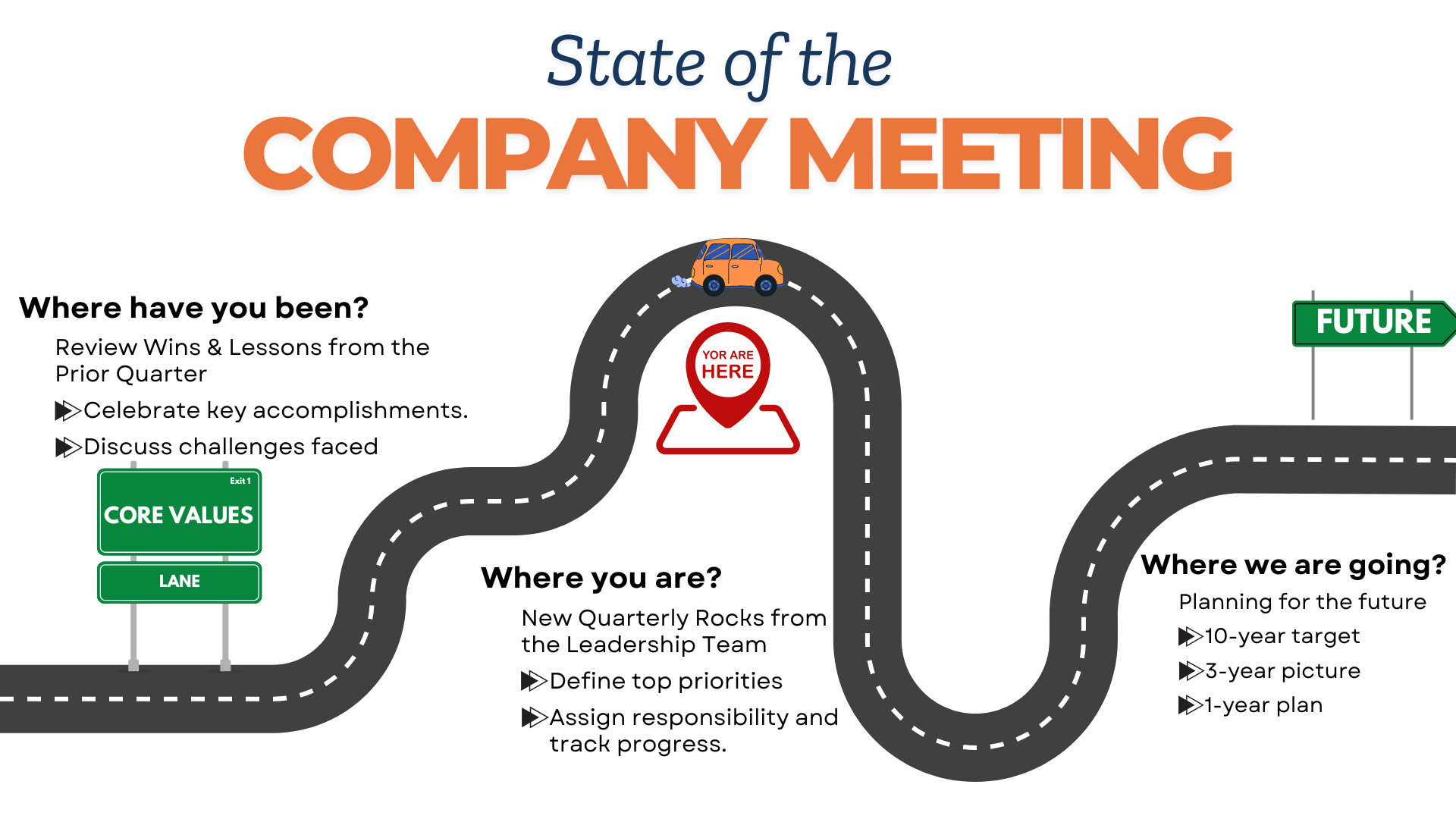
A State of the Company meeting is a powerful tool for leadership to align the team, celebrate progress, and set a clear course for the future. These meetings provide an opportunity to reflect on past successes and challenges, establish new priorities, and ensure that everyone in the organization understands the company's vision. Why Hold a State of the Company Meeting? A well-executed State of the Company meeting provides several key benefits: Aligns the Team: Ensures everyone understands company goals and priorities, creating cohesion across departments. Boosts Morale: Celebrates wins and recognizes contributions, reinforcing a positive and motivated workplace culture. Enhances Transparency: Keeps employees informed about company performance, financial health, and upcoming strategic initiatives. Encourages Engagement: Gives employees a voice in company initiatives, allowing them to provide input, ask questions and most importantly see how they contribute to the overall success of the company. Strengthens Company Culture: Reinforces the core values and mission that drive the organization forward. Planning the Meeting Set a Clear Agenda A structured agenda helps keep the meeting focused and productive. Ensure that it follows a logical flow that engages employees while delivering meaningful updates. Here’s a suggested structure: 1. Reinforce Core Values A strong company culture starts with reinforcing Core Values. Leaders should use this opportunity to demonstrate that company values are not just words on a wall, but principles that guide daily decision-making. Consider these activities: State the Core Values including what each of the Core Values means. In EOS we call this the Core Values “Speech”. It gives definition to the meaning behind the words. Show a Core Values video to remind employees of the company’s mission and culture. Do a real-time People Analyzer. This can be an initiated self-assessment stressing the importance of Core Values fit for the company. Recognize team members who exemplify Core Values (Core Value Shoutouts). Public recognition encourages employees to live out the values in their work. 2. Review the Past: Where Have We Been? Quarterly Wins & Learnings Celebrate key achievements and highlight Rock completion from the last quarter. Recognizing milestones helps maintain motivation and demonstrates progress. Highlight major lessons learned and their impact on the company. Transparency about challenges fosters trust and encourages a growth mindset. 3. Assess the Present: Where Are We Now? New Quarterly Rocks & Goals Present the key priorities for the upcoming quarter. What are the focus areas that will drive success? Assign ownership and accountability for each Rock. Clearly define who is responsible for what to ensure execution. Provide updates on current projects and challenges. Keep employees in the loop on important initiatives and any obstacles the company is facing. 4. Look to the Future: Where Are We Going? Long-Term Vision Alignment 10-Year Target: Reinforce the company’s long-term vision. Help employees understand how their work contributes to a bigger goal. 3-Year Picture: Review projected milestones and strategies that will move the company closer to its long-term objectives. 1-Year Plan: Outline key focus areas and metrics for the next 12 months. Provide clarity on what success looks like in the short term. Best Practices for a Successful Meeting To ensure your State of the Company meeting is both impactful and inspiring, follow these best practices: Keep It Concise & Engaging: Avoid lengthy presentations filled with jargon. Use visuals, storytelling, and real-life examples to maintain engagement. Involve Leadership: Have department heads present updates to show unity and alignment. Celebrate Successes: Publicly acknowledge individual and team contributions to create a positive and motivated atmosphere. Follow Up: Summarize key takeaways, document action items, and schedule check-ins to track progress. End on an Inspiring Note: Close with a motivational message that leaves employees energized and ready to contribute to company success. Final Thoughts A well-structured State of the Company meeting can energize your team, align everyone toward common goals, and ensure that the company’s vision remains top of mind. By making these meetings a regular part of your EOS framework, you foster a culture of clarity, accountability, and long-term success. The more transparent, engaging, and inspiring these meetings are, the more likely employees will feel connected to the company’s mission and motivated to contribute to its growth. By consistently holding State of the Company meetings every 90 days, you create a workplace where employees feel valued, informed, and empowered—essential elements for long-term business success.

Running a business can feel like being in a one-sided relationship. You give it your time, energy, and focus, yet you’re constantly dealing with the same challenges. You answer the same questions, fix recurring mistakes, and spend your days putting out fires. No matter how much effort you put in, it feels like the chaos never stops. The truth is, without clear and repeatable processes, your business depends too much on you or a few key people to keep things running. This creates stress, unpredictability, and burnout. It also makes it harder to grow or sell the business because a company that can’t function without its owner isn’t attractive to buyers. The good news is that when you take the time to document and refine your processes, everything becomes more efficient. Your team gains clarity, daily operations run smoothly, and decision-making becomes easier. Instead of constantly managing crises, you can shift your focus to growth and long-term success. A business with strong systems is not only more valuable but also far less stressful to manage. This Valentine’s Day, show your business some love by giving it the structure and organization it needs to thrive. A well-run business, like a strong relationship, should support and empower you, not drain you.

The body content of your post goes here. To edit this text, click on it and delete this default text and start typing your own or paste your own from a different source.

In today's fast-paced business world, maintaining organizational health is crucial for long-term success. One powerful tool that can help companies assess and improve their overall health is the Entrepreneurial Operating System (EOS) Organizational Checkup. In this blog post, we'll explore how this checkup can strengthen your company and drive sustainable growth. What is the EOS Organizational Checkup? The EOS Organizational Checkup is a simple yet effective assessment tool developed as part of the Entrepreneurial Operating System. It consists of 20 questions that evaluate various aspects of your company's health, including leadership, vision, execution, and team dynamics. Key Benefits of the EOS Organizational Checkup Identify Strengths and Weaknesses: The checkup provides a clear picture of where your company excels and where it needs improvement. Align Your Team: By involving your leadership team in the assessment, you can create a shared understanding of your company's current state. Set Priorities: The results help you focus on the most critical areas that need attention, allowing for more effective resource allocation. Track Progress: Regular checkups enable you to monitor improvements over time and adjust your strategies accordingly. Enhance Communication: The process encourages open dialogue about your company's health, fostering better communication within your team. How to Implement the EOS Organizational Checkup Gather Your Leadership Team: Ensure all key decision-makers are involved in the process. 2. Take the Assessment: Have each team member complete the 20-question checkup honestly and independently. Discuss the Results: Review the collective responses as a team, focusing on areas of agreement and discrepancy. Develop an Action Plan: Based on the results, create a plan to address the most pressing issues identified. Set Regular Check-ins: Schedule periodic reassessments to track progress and maintain focus on improvement. Conclusion The EOS Organizational Checkup is more than just a diagnostic tool—it's a catalyst for positive change. By regularly assessing your company's health and taking action on the insights gained, you can create a stronger, more resilient organization capable of achieving its full potential. Remember, organizational health is an ongoing journey, not a destination. Embrace the EOS Organizational Checkup as a valuable compass to guide your company towards sustained success and growth.

There has been much recent talk of the aging population and with it naturally comes the aging of business owners. This has led to a dramatic increase in those seeking to exit their businesses both now and over the next 12 years. What is important to realize for business owners is that business succession planning is not about leaving it until the last possible moment and then determining the most suitable exit. I had a great discussion at a meeting last week about the fact that professional investors (private equity firms, angel investors, and venture capital firms) all require detailed information about the exit strategy before they enter the investment. As amateur investors (small business owners) we are often so concerned about the entry – funding, IT, personnel, premises, set up, marketing, etc. that we don’t have time or give thought to properly planning for the exit. What is vitally important therefore is that as we start to prepare for an exit we allow sufficient planning time to design the most suitable strategy and more importantly to allow us time to implement the succession plan properly. I am seeing a number of business owners where the amount of money they require for retirement is dramatically more than the real value of their business either because they’ve never had the business value determined or because their own expectations of value are quite different. The solution is simple – time. I am currently working with a number of clients where we have a 5-to-7-year exit horizon. This allows us to strategically design the most appropriate exit strategy and more importantly introduce a succession planning coach who will manage the implementation of that strategy over an extended period to ensure the owner can exit the business extracting the value they actually need and deserve. Business owners who wait until they are 64 years and 9 months old and simply list the business for sale through a business broker will never extract the value they potentially should or could if the exit had been strategically planned properly. To ensure you maximize your exit value as part of any business succession or exit plan – ensure you start the process at least five years before you expect to exit.